

Note
Go to the end to download the full example code.
Thetan Sequential vs Thetan Berserker on a grid of Gaussians#
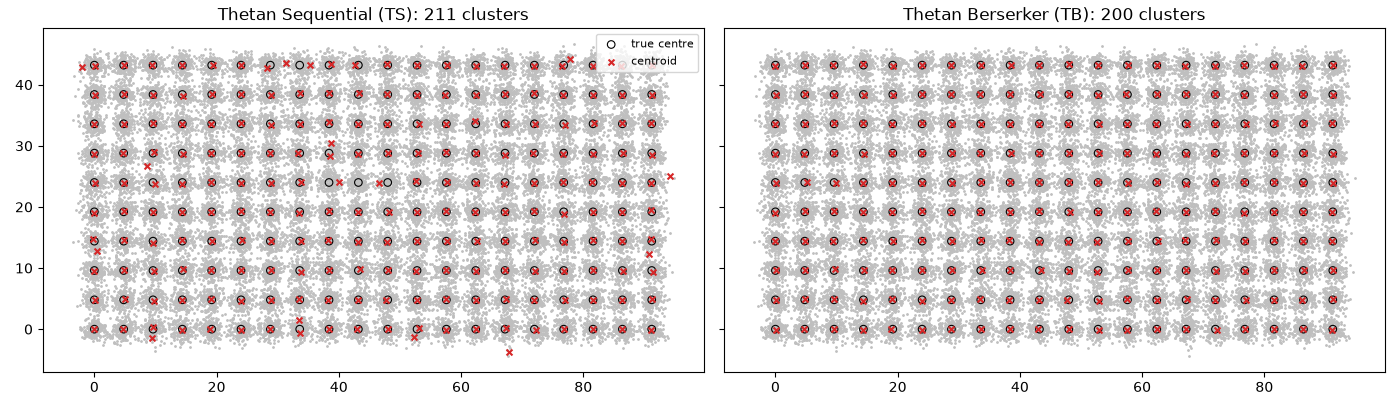
Cluster 200 Gaussian blobs laid out on a 20 x 10 grid with one distance threshold, θ, and compare one pass of Thetan Sequential (TS) with the two self-correcting passes of Thetan Berserker (TB). Neither method is told how many clusters there are.
import matplotlib.pyplot as plt
import numpy as np

from thetan import TB, TS
Simulate the data#
Each blob is a unit Gaussian with 200 points. The centres are 4.8 apart, so a threshold of θ = 3.6 is larger than a typical cluster and smaller than the gap between two neighbours.
rng = np.random.default_rng(42)
np.random.seed(42)

spacing = 4.8
n_x, n_y = 20, 10
n_per_cluster = 200

gx, gy = np.meshgrid(np.arange(n_x) * spacing, np.arange(n_y) * spacing)
centres = np.column_stack([gx.ravel(), gy.ravel()])
X = np.vstack([c + rng.standard_normal((n_per_cluster, 2)) for c in centres])
X = X[rng.permutation(len(X))]
X = np.ascontiguousarray(X, dtype=np.float64)

print(f"{X.shape[0]} points, {X.nbytes / 1024**2:.1f} MB, {len(centres)} true clusters")
40000 points, 0.6 MB, 200 true clusters
One pass: Thetan Sequential#
TS visits each point once. A point joins its nearest centroid when it is closer than θ; otherwise it opens a new cluster. It is fast, but a point seen early can open a cluster between two true groups.
theta = 3.6
ts_centroids, ts_labels = TS(X, theta)
print(f"TS found {len(ts_centroids)} clusters")
TS found 211 clusters
Two passes: Thetan Berserker#
TB removes the duplicate centroids of the first pass, then runs a second pass with the cleaned centroids placed in front of a new shuffle of the data.
tb_centroids, tb_labels = TB(X, theta)
print(f"TB found {len(tb_centroids)} clusters")
TB found 200 clusters
Compare the centroids with the true centres#
Red crosses are the centroids each method returns and black circles the true centres. The extra centroids of TS sit between blobs; TB’s land on the centres.
fig, axes = plt.subplots(1, 2, figsize=(14, 4), sharey=True)
for ax, centroids, name in ((axes[0], ts_centroids, "Thetan Sequential (TS)"),
                            (axes[1], tb_centroids, "Thetan Berserker (TB)")):
    ax.scatter(X[:, 0], X[:, 1], s=1, c="0.75", rasterized=True)
    ax.scatter(centres[:, 0], centres[:, 1], s=30, facecolors="none",
               edgecolors="k", linewidths=0.8, label="true centre")
    ax.scatter(centroids[:, 0], centroids[:, 1], s=18, c="tab:red",
               marker="x", label="centroid")
    ax.set_title(f"{name}: {len(centroids)} clusters")
    ax.set_aspect("equal")
axes[0].legend(loc="upper right", fontsize=8)
fig.tight_layout()
plt.show()
Total running time of the script: (0 minutes 0.354 seconds)